Welcome!

Ian Randall is an educator, artist and author at Cambridge University Press.
You can view examples of artworks or obtain further information here.

lladnarnai@gmail.com

Sunday, June 24, 2012


Penrith Anglican College

Term 2 - Week 10

Year 8 - Abstract Art  Work Sheet

            - Abstract Artworks by the students

Students from Year 8 have created an amazing collection of abstract paintings and drawings - here is a sample.

Sunday, May 27, 2012

Farewell !

Farewell Staff, Parents and Students of Mountains Christian College.


Thank you for making my time at your school so full of blessing.

Mr Randall

(Last day, June 7th)

Thursday, May 10, 2012

Archibald Prize Paintings - 9/10 Visual Arts

This wonderful portrait is by Bonnie Trist (Yr.10) of her Youth Group Leader, Margery.
"Margery is very kind and loved by all. She is a great cook and she makes lovely food for our group. She picks me up and drops me home. She also invites me and my sister to her house. We love it when she takes us out on outings."
Bonnie  


Wednesday, May 2, 2012

Food Technology Term 2

We are having lots of fun preparing a three course meal for a special group of friends and family. Each student is designing their own invitations, theme and menu for the evening. click here to see our first menu item.


Sunday, April 22, 2012

PhotoComp 2012

Congratulations to students who entered this years PhotoComp.

This image was taken by Fiona O'Neill in Yr 8 - WINNER OF SECONDARY


Click here to view some more samples


Tuesday, February 28, 2012

Year 9 Poetry

This term we have been reading, studying and writing poetry.

This is motley (and somewhat irreverent) collection of love poems written by the students after our study of The Highwayman, by Alfred Noyes (1880-1958).

Students were inspired by the depth of love between Bess and The Highwayman. One of the students began by describing their love with the words "if it were a love like that. . . " so became the opening lines of their poems.

Please enjoy - click here

Monday, February 20, 2012

Year 10 City Camp - Rough Edges

This year’s Year 10 camp is going to be an exciting challenge in the city. Students will venture into the city, learning to catch public transport, find their way around the city, discovering some interesting sites and learning to be a little more independent of the comforts of home. The students will be learning about the every present issue facing people within our society, homelessness. We will be visiting an important outreach to homeless people in the heart of the city at St John’s Anglican Church, Darlinghurst, called Rough Edges. Here's a little glimpse of what they do.


Sunday, January 29, 2012

What is Postmodernism?

I am frequently being asked to explain what is Postmodernism.

To a contemporary reader it is like explaining to a fish what it is like to be wet. If you have the breath of life in you then you have spent your entire life in a Postmodern age.

You are a Postmodernist - You are wet !

So fish - let me try to explain what it is like to be wet.

We are living in an age POST (or after) the 'Great' Modern Age. This was the historical period from the Renaissance until the 'Great' War, 1914. This period of around 500 years encompassed the Renaissance, Reformation, Enlightenment, Industrial Revolution, etc. It was an age of progress and conquest, mass migration and navigation, people were swept from every corner of the globe. Empirical knowledge, facts, truth was something to possess and to control. History was the history of Western civilisation. It was the age of scientific discovery, global economics, triumphalism, nationalism and rationalism and the white male 'genius'.

The Modern Age raced at full speed, head long, unchecked and unquestioningly into the Great War. Men were to become heroes, see the world and be home for Christmas. Instead they met the machine gun, military rationalism and a four year war of attrition. The Allies had 6 million soldiers, the Hun's had 4 million, if every one of ours kills one of them before he dies, we've won! - was the Allies strategy.

As you can imagine, nearly 60 million deaths of men, women and children caused something of a re-think about the 'Great' Modernist project. Numbers of intellectuals, poets, writers and artists started to question the assumptions of Modernism and to reject all that was seen to contribute to such destruction. So a new spirit of cynicism, skepticism and questioning spread and was to be recognised as a new historical era.  This new historical period proceeded Modernism and was at the same time irrevocably connected to it. Throughout the Twentieth Century modernism continued to flourish but was coupled with a new self-awareness, self-reflection and self-critical questioning. Postmodernism has many different manifestations in art, architecture, literature, science and in all branches of human endeavour.

Today, Modernism can be seen in areas of international politics, consumerism, globalisation and free market capitalism. Postmodern voices continue to call for a 're-think' of modernist values. Postmodern people are saying 'No' to environmental degradation, social injustice and racial genocide. The 're-thinkers' are swelling in numbers and are becoming a political force via the proliferation of the Internet and social networking. So much so that in many areas the postmodern re-think is becoming the mainstream. You see it when you put out your recycling each week, drink Fair Trade coffee, buy 'organic' veggies, say 'no' to plastic bags, laugh at the ironic cultural references in the Simpson'ssponsor a child in the developing world and subscribe to Amnesty International's emailing list. It is now 'OK' to believe in spirituality, have a religion, learn the ukulele and join a community 'Landcare' group. World history is now understood as multiple cultural 'stories' and the Bible is re-discovered as a 'narrative' rather then a fragmented list of facts and dogma.

The Modernists continue to hold positions of power and privilege and will do all they can to maintain it - but there is an ebb-tide gathering where the masses are starting to swell and are realising that they can make a difference. Just consider the spread of the 'Occupy' movement calling for the end to 'corporate greed'. After the Global Financial Crisis Governments are now at least considering how to make the open market more accountable, more equitable, or at least getting CEO's to pay a fair tax-rate.

Students (Gen Y's) of today are plugged into modern 'pop' consumerist techno culture yet sceptical about their future and are critical about what 'authorities' present. Through the internet they form vibrant communities and want to be engaged in making positive changes in their world. They want to live rich (not $) lives full of meaning and purpose, to be more then a cog in a corporate wheel. Students today need to be given opportunities to consider their options, to be agents for change and we need to encourage our students to continue the postmodern 're-think' and give them the positive opportunities to act on their beliefs.

So, now do you feel wet?


- I imagine this explanation is a work in progress.  
I will continue to edit and change it as I think of better ways to explain Postmodernism - 


A little reading list on Modernism & Postmodernism.

Marshall Berman - All that is solid melts into air. 
Charles Jenks - What is postmodernism
Jean Francois Lyotard, The Postmodern Condition

Ian Randall

Response:

Post-modern literature does not begin until after World War II. There are some interesting nuances of meaning compared to Art and Philosophy. The impact of post-modernism in literature is that it opens up the meaning of all texts as it places meaning in the hands of the reader only. It doesn't matter what the author intended, you can imagine what that does for the authority of the Bible. Post-modernism has taken away the idea of a canon of literature. All texts are equal, I have sat through a lecture where we were told that The Bold and the Beautiful had just as much merit as Keats or once again the Bible. Interestingly, there is a backlash to this that is just beginning to gain momentum, in stage 6 English we do texts and contexts, all of a sudden the author's intention matters. The new curriculum is also favouring context rather than the void that the post-modernists like to operate in. In terms of Christianity, I think that post-modernism has denied absolute truth and therefore set itself up in opposition to the Bible and ultimately God. The only point of having an open mind is to shut it firmly on the truth! - K. Leong 


There is post-modern philosophy and there is the post-modern time period; do you think that someone living in post-modernity by default has a post-modern worldview/philosophy?! You mentioned that there still are sections of society that are shaped by "modern" thinking. Maybe where we differ is the amount of trust we place on how much influence this powerful group are still having in shaping the worldview of the fish. I think our young people are a very confused mix causing them to feel somewhat hopeless. - C. Parker

Wednesday, January 25, 2012

Subscribe to Mr Randall's Calendar


Use the link below

Coles, the Christian Supermarket

I just love the way Coles supports Christian culture all year round.

From the beginning of January we can purchase Hot Cross Buns to help us prepare for Easter.

And from April we see images of St Nicholas and hear Christmas Carols.


Thank you Coles


I hate . . .

               . . . back to school advertisements which appear the week after Christmas!

Tuesday, November 22, 2011

Noodles !


Just a little note about all those noodles you're eating for lunch.
Have a look at the ingredients, all that salt and flavour enhancers can't be good.
You need to learn about Ingredient Numbers and their effects, especially  621 & 635.
A not very stylish but helpful website about food additives click here

Noodles are a great quick meal - just not every day.
(especially if your having learning or behavioural issues)

Environmental Sculpture 'in progress' - 'Bird Nest' by Year 7


Where's big bird ?

An environmental sculpture by Year 7 students inspired by British artist Andy Goldsworthy.


Monday, November 21, 2011

Trafficking in Human Beings

I recently attended an NGO round table with UN Special Rapporteur on Trafficking in Persons, Ms Joy Ngozi Ezeilo. I was representing the Third Order of the Society of St Francis (TSSF).

The statistics regarding Human Trafficking are staggering - 1.4 million people (56% of world-wide total) are in Asia and the Pacific area; which includes Australia and New Zealand.

The meeting was tightly chaired with many stake holders eager to present their work to Ms Joy Ngozi Ezeilo. Time was limited and opportunities were few. Representatives from many organisations were present, all wanting to present their concerns and outline the work they are doing. Significant time was given to the Salvation Army, World Vision, ACRATH, Scarlet Alliance and the Australian Red Cross. Unfortunately there was not an opportunity for me, and many others, to speak or even greet Ms Joy Ngozi Ezeilo. It was recommended to those of us who were unable to speak to write to the organisations present and to the Special Rapporteur directly, which I will do on behalf of the TSSF.

Some background, major themes and issues raised at the meeting are outlined below.

In Australia, it has long been a crime to bond a slave and recently to engage in forced labour, yet such practices continue in our country.

Australia's current political climate is seeing the blurring of boundaries surrounding refugees and trafficked people. It is politically expedient for distinctions between smuggling and trafficking to be blurred yet the distinctions need to be upheld. The two issues must be seen as distinct as trafficked persons will find themselves not as 'victims' but as an 'illegal' person ending up in Federal Police custody and Immigration Detention. One of the major problems with modern slavery is a lack of documentation. Trafficked people without documentation have limited access to legal representation, linguistic services, housing and health care. Advocacy and representation for trafficked people must be increased through Government funding and social awareness. Anti-Slavery Australia have produced a range of online resources in an attempt to raise social awareness of the plight of people trafficked to Australia (see below for details).

The Salvation Army currently funds, entirely through donations, accommodation and representation for ten women who have been trafficked to Australia. This work is at a grassroots level and treats each person according to their needs. This work is vital but it was recognised as a drop in the ocean in dealing with the victims of trafficking.

World Vision called for the need to continue to hold corporations accountable for creating goods using trafficked people. Corporations must disclose the full nature of their production from the sourcing of raw materials to the production of final product. Consumers understand the supply chain model and the power of boycotting products. Many current campaigns have been successful in raising consumer awareness, for example the production of chocolate.

Corporations need to be continually reminded that there is a direct link between business and human rights. It is critical that NGOs and Governments continue to engage with business to scrutinize their supply chains and to respond domestically to international issues.

The major issue covered at the meeting was the trafficking and exploitation of migrant workers, trafficked people and students in Australia's sex industry. As you can imagine there were a huge range of views represented and emotions were at their peak. Prostitution is currently prohibited in many parts of Australia and where it has been legalized it is inconsistently regulated. Granting visas to sex workers will have a large effect on the trafficking of people from Southeast Asia. The point was made by the Rapporteur that prohibition of prostitution only produces a restructured industry rather than the destruction of that industry. Prohibition will only continue the trafficking of people into Australia for this industry. The legalization of the sex industry does not morally legitimise the industry but rather enables it to be regulated, studied and for people to be held accountable and monitored. The granting of a working visa to sex workers is a political anathema yet may be what is required to care for those caught in the industry and to curb the trafficking of people into Australia.

What you can do about it?
- Be a knowledgable consumer and demand that organisations disclose production processes.
- Support organisations who are actively working to end slavery.
- Engage in public debate and call for greater regulation of the Australian sex industry.
- Pray for those trapped in slavery in our country.

For further information
Anti-Slavery Australia
UN Special Rapporteur on Trafficking in Persons Ms Joy Ngozi Ezeilo
a recent article on ABC PM


Wednesday, October 26, 2011

Sport Art! - Yr.5/6

Class 5/6 had a fun afternoon creating exciting designs with sporting equipment

Click here

Sunday, September 18, 2011

CYCLE FOR SMILE

ADELAIDE TO MELBOURNE 7-11 September 2011

Photo's click here

- DAY 1
We have arrived safely at camp at Salt Creek after a fast first day on the road. What surprised me was that the core riders are just every day guys, no elite cyclists here. Even after 200km every day for 70 days they all get pains, get tired and puff and pant away. We are also joined by a small cycling team from SthAfrica, sponsored by NOBLE ENERGY, who don't seem to need to breath at all - cycling machines! The setup is simply impressive, complete with a chef, massage therapist and support crew who pitch and pack up our tents. The food is amazing! The ride out of Adelaide was over the undulating hills through little towns with little stand stone cottages. We stopped in Strathalbyn for a meal after the first 100 and were served a full cooked breakfast. I had thought that breakfast was the Wheetbix I eat at 6am. The last 100 was riding into a headwind across a salt flat. So far the SMILE riders have raised over $1.4m for research into rare childhood diseases. For the tech-heads Average speed 33km/hr - No graphs sorry.

- DAY 2

After 245km I'm in Mt Gambier sitting warm and contented in front of my empty dinner plate. I spent the day with one of the Sth African riders hearing about how he became a professional cyclist. Anton started riding at 17 to get work at a bicycle repair shop, 80km away from his home. A year later he won his first race - chasing down a break away on his own and then won the sprint to the line. In his own words he is one of the only coloured pro-riders he races against. With NOBLE ENERGY's support of Sth African cycling, he has a great future on the bike. He has been ride for NOBLE now for 3 years. He is also about to get married when he gets home. We've just had word that tomorrow is going to wet and cold with the head wind picking up.
Today we broke the ride into 110/80/55km into an increasing head and cross wind.
Average speed: 31km

- DAY 3
Today was a day of attrition. The severe winds and rain battered us and saw a number pull out and sit one of the legs in the support van. Two of the SMILE riders arrived in Warrnambool nearly two hours later than the main group. Some of them are feeling the now 72 days and are starting to worry about making it on time to some of the functions planned in Mel/Can/Syd. And google is predicting more of the same weather. Today's cross winds meant that it was hard to find shelter. I had a good first 100km but the last 80 was the most I've suffered on a bike. I was hoping to make it to Melbourne without treating the SMILE riders as Sherpa's but during the last leg I didn't have to ride on the front taking brunt of the wind. My bike has been excellent and was well prepared for my journey by my good friends at BIKEMINDED. Many thanks.Average speed- who cares!
- DAY 4
It's all about perspective.
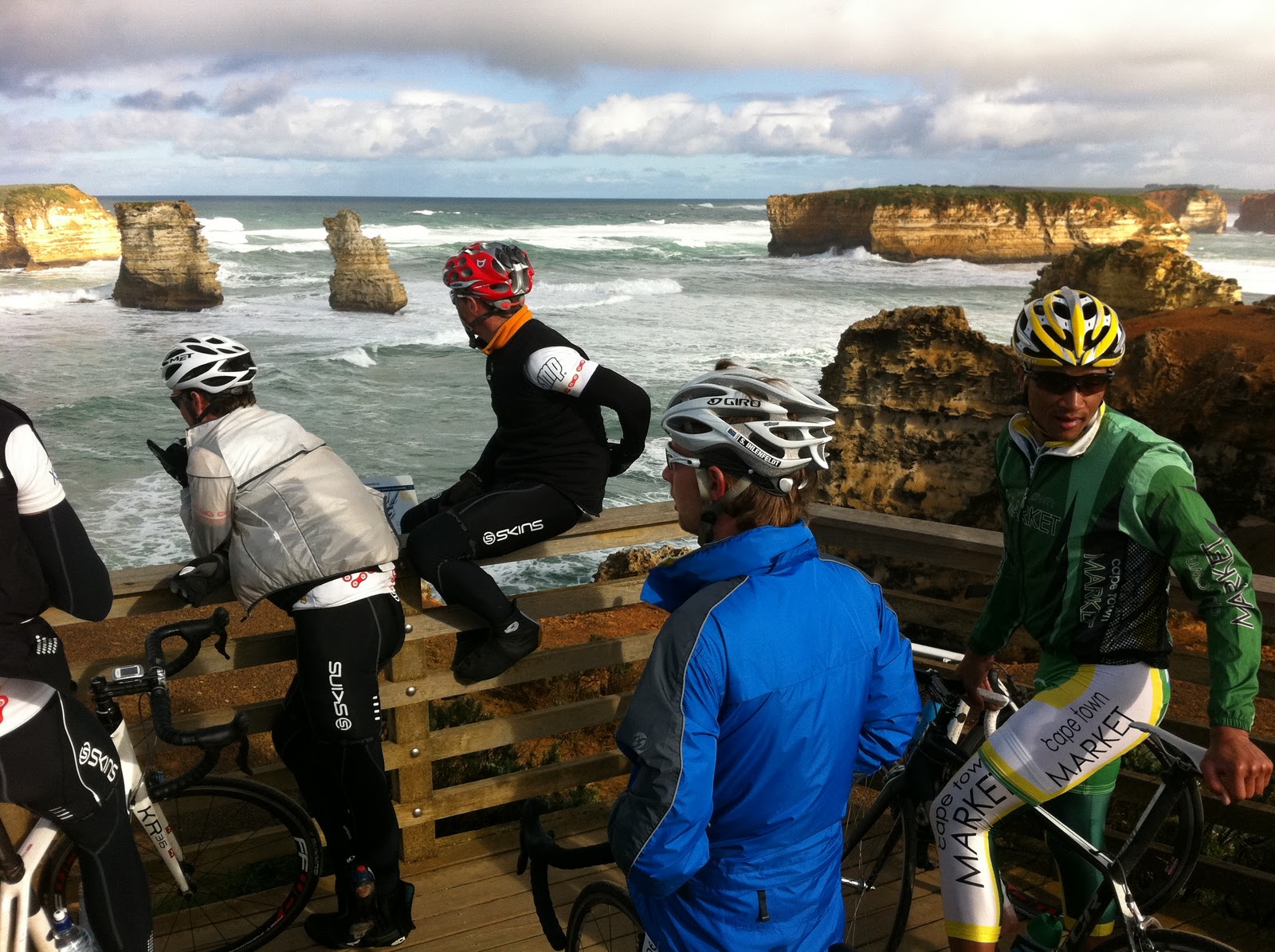
As we rode along, without argument, the most picturesque road in Australia and facing the predicted weather conditions, I called out to two brave elderly Mountain bikers who had abandoned a climb and were walking their bikes "Where would you rather be?"
I heard one of the SMILE riders behind answer "Long Bay gaol!"
I was having my greatest day on a bike. I felt I was on my own epic odyssey, I was not feeling the cold the wet or the 130000km!
I was pleased that over dinner the boys said that was the most spectacular days ride of the trip.
I hope those two old men made it up that hill. I'm sure they're telling the world about it. Distance - 240km Average - 27kmph
Tomorrow we ride from Aireys Inlet to the Melbourne ferry. On the other side we pick up a pelaton of local riders who will accompany us to a function in the city. The end of the road for me.

- DAY 5
I'm packed and about to grab some breaky before my flight back to real life.
Here are some practical, philosophical and spiritual things I've learnt on this trip.
- Aloe vera gel works a treat for all minor and major skin irritations.
- Wool is the best base layer.
- Except in NSW, people love cyclists.
- Roads in NSW are the worst in Australia (and we know the roads in the Blue Mts the worst in NSW!).
- yes, tire punctures are uncommon! The SMILE riders hardly had any on their entire trip. We only had one in 1000ks and it was because a tire wore through.
- Tall heavy cyclists do exist. 3/6 of the SMILE riders were bigger than me!
- When you think your on the last hill there will be another round the corner (you'll always find the strength to get up it - 'dig deep')
- When you're pushing hard to keep up with the rider in front there is little time to stop for photographs.
- Cyclists universally have no shame and will stop to 'go' anywhere - it's the 'Lycra license'
- If you are just not coping, we were told to take a 'tactical'. Get the roll of toilet paper find a bush and lie down for ten minutes. No one will ever know.
- No body can do anything on their own, support each other in small ways, taking small turns in the wind, to make it through life's long journey.
- When you see a double rainbow over the ocean after climbing out of a rainforest valley you can only give praise to God.

May God Bless you all - thanks for your thoughts and prayers.
Ian Randall

17th September - WAITING IN SYDNEY FOR THE HOME COMING
THREE CHEERS ! ! !


Monday, September 5, 2011

Where is Mr. Randall?


. . . . riding his bike from Adelaide to Melbourne

The SMILE (Supporting Medical Innovation for Life Enhancement) Foundation provides financial assistance to families whose children suffer from rare diseases as well as much needed funding into medical research.

You can follow Mr Randall by clicking the here

Sunday, September 4, 2011

HSC Visual Arts - New Case Study

Frames Work Sheet
Local Art Gallery Case Study

Visit a local Art Gallery and write an exhibition review.

Length – 500 words 

In your review you need to make comment on the following;
- The role of a gallery in a local community.
- How the artist became associated with the Gallery.
- How the Gallery supports the Artist.
- Review an artwork in the exhibition using the Frames Work Sheet
- Submit with your work some published material, information sheet, flier or business card - proof that you visited the gallery.

Local Galleries to Visit

- Hat Hill Gallery - 3 Hat Hill Road, Blackheath -
(02) 4787 7033
- Blackheath Art Gallery - 44 Govetts Leap Road, Blackheath -
(02) 4787 8800
- Katoomba Fine Art - 98 Lurline Street, Katoomba
(02) 4782 1220
- Nolan on Lovel - 56a Lovel Street, Katoomba
(02) 4782 6231
- Lost Bear Gallery - 5/146-148 Leura Mall, Leura
(02) 4784 1440
 
Before you go - call them to check opening hour.

Monday, August 15, 2011

Christian Education - Orphans in the classroom


Hosea 14:3 .. in you alone do the orphans find mercy. 
Matthew 19:14 ... Jesus said, "Let the little children come to me, and do not hinder them, for the kingdom of heaven belongs to such as these." 
From Wiki - 
In the common use, an orphan does not have any surviving parent to care for him or her. However, the United Nations Children's Fund (UNICEF), Joint United Nations Programme on HIV and AIDS (UNAIDS), and other groups label any child that has lost one parent as an orphan.
I recently had the opportunity to attend a presentation by Greg Beech CEO from Homes of Hope.  He highlighted the overwhelming and distressing problem of orphans in our world. He explored the reason behind the UNICEF definition of an orphan, which includes children who have lost one or both parents. This definition sees the global proportion of orphans as 1/13 children.  Commonly a child will loose their father, leaving the mother and child in a most desperate situation, often resulting in the eventual abandonment of that child. In Jakarta, Homes of Hope are raising funds to build an orphanage to house up to 60 children. 

In affluent Australia there are school children who are in many ways orphans. Although they are not suffering the same plight as those in developing countries, nevertheless, they are abandoned and in alone in the world. Our orphans come from broken or multiple homes, living with Grandparents or careers, or with parents who have lost patience with an 'out of control' teenager. These are the children who are accountable only to themselves; they put themselves to bed, launder their own clothes, find their own money, prepare their own meals, care for their siblings and even are responsible for nursing other family members. Their lives are troubled and out of their control, they come to school without adequate food, without the basic school equipment, unwashed and out of uniform.

I wonder whether we need to care for these students as the orphans that they are.

Christian Education must emphasis the Christ in Education. If Jesus was at our school what would he be most concerned about?  I see Jesus ensuring that our orphans were fed, warm, washed, clothed, rested, listen to and understood, well before the bell rang for the start the school day. Jesus would give them the care and security all children deserve, see that their physical and emotional needs were met and then "off to class." 


Within our schools we need to consider how we can provide the facilities that our orphans need; breakfast clubs, fresh lunches, clean bathrooms and washrooms, counselling, medical and health assistance, spare clean uniforms and casual cloths . . . (?)

I think that Jesus would be one of those teachers who would always be late to class. 
Oh, and Jesus would teach Design and Technology.


Just a teacher thought,
Ian Randall

CJ Hard At It

As the HSC deadline approaches the students step up to the mark


Sunday, August 14, 2011

A blackboard of inspiration!

What a great classroom idea!

Even more Chocolate!

click to view student work


90% of Success

"90% of Success is just showing up" Woody Allen 
an unrelated image showing 90%!?

Good education provides students the confidence to get involved in life.
Participating in an enriched school experience is essential for students to develop confidence within themselves, so that they will not shy away from opportunities which come their way.
When students leave school there are so many ways they can participate in their community; joining an acting society, volunteering, participating in sport or a music group. It is often through 'showing up' that you make new friends, establish contacts and encounter further opportunities.
As teachers let us continue to encourage our students to get involved and provide opportunities for them to do so.

Just a teacher thought,
Ian Randall